Environmental Testing Before Remodeling California Homes: A Pre-Renovation Guide
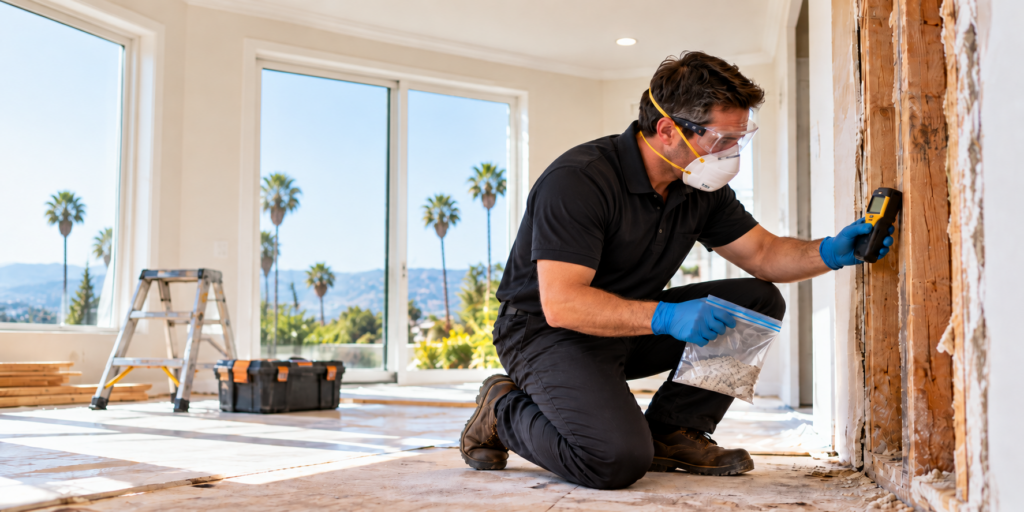
Planning a renovation? Environmental testing before remodeling can help California homeowners identify potential asbestos, lead, mold, moisture, and indoor air quality concerns before demolition or renovation work begins.
You may already have the plans, contractor, flooring, cabinets, and finishes selected. But before anyone starts opening walls, removing old flooring, scraping ceilings, or tearing out existing materials, there is another important question to consider:
Does my home need environmental testing before remodeling?
Not every California remodeling project requires every type of environmental test. However, environmental testing before remodeling may be appropriate when renovation work could disturb building materials, expose hidden moisture problems, or affect indoor air quality.
Renovation can disturb building materials that have remained behind walls, ceilings, flooring, insulation, and layers of paint for decades. Depending on the property and the materials being disturbed, those areas may involve asbestos, lead-based paint, moisture damage, mold, or other indoor environmental concerns.
Identifying potential hazards before demolition begins can help homeowners and contractors plan appropriately, reduce unexpected project delays, and avoid discovering an environmental concern halfway through construction.
Quick Answer: Do I Need Environmental Testing Before Remodeling?
Environmental testing or an environmental assessment may be appropriate—and in some situations required—when a renovation will disturb:
- Suspected asbestos-containing building materials
- Painted surfaces in a home built before 1978
- Older flooring, adhesives, ceilings, insulation, or wall systems
- Areas affected by previous leaks or water damage
- Materials showing signs of moisture or microbial growth
- Building components subject to local asbestos requirements
The appropriate evaluation depends on the age of the property, location, materials being disturbed, scope of work, and applicable regulations.
California’s asbestos construction regulations apply to construction work involving asbestos, including demolition, renovation, alteration, repair, and removal of asbestos-containing materials.
The safest approach is simple: Know what you are about to disturb before demolition begins.
What Should Be Tested Before Remodeling or Demolition?
The most common environmental concerns to consider as part of environmental testing before remodeling include:
| Potential Concern | When to Consider Evaluation |
|---|---|
| Asbestos | Before disturbing suspect flooring, ceilings, insulation, drywall systems, roofing, mastics, or other building materials |
| Lead-Based Paint | Especially when disturbing painted surfaces in homes built before 1978 |
| Moisture | After leaks, flooding, plumbing problems, roof problems, staining, or suspected hidden moisture |
| Mold | When the source or extent of suspected microbial growth is unclear |
| Indoor Air Quality | When unexplained indoor environmental concerns exist or major construction may affect occupied spaces |
You may not need every test listed above.
A pre-renovation environmental assessment should focus on the materials and areas your remodeling project will actually disturb.
1. Asbestos Testing Before Remodeling
Asbestos is one of the most important environmental concerns to consider before demolition or remodeling because asbestos-containing materials can look completely ordinary.
Potential asbestos-containing materials can include:
- Floor tiles
- Vinyl sheet flooring
- Flooring backing
- Flooring adhesives and mastics
- Acoustic ceiling materials
- Popcorn or textured ceilings
- Drywall systems
- Joint compound
- Plaster
- Textured wall coatings
- Pipe insulation
- HVAC insulation
- Roofing materials
- Cement products
- Fireproofing materials
- Some insulation products
Because these materials may not be identifiable by appearance alone, environmental testing before remodeling may include asbestos sampling and laboratory analysis when a suspect material could be disturbed during construction.
California regulations specifically recognize materials such as floor tile, roofing products, wallboard, mastics, insulation, and sprayed-on materials as materials that may contain asbestos.
Can You Tell If Something Contains Asbestos by Looking at It?
Usually not.
Many asbestos-containing building materials look no different from materials that do not contain asbestos.
Visual inspection alone generally cannot confirm whether a suspect material contains asbestos. When identification is necessary before demolition or renovation, sampling and laboratory analysis may be appropriate.
Why Is Asbestos a Concern During Remodeling?
An asbestos-containing material may remain relatively undisturbed for years.
Renovation changes that.
Activities such as:
- Cutting
- Sanding
- Grinding
- Scraping
- Drilling
- Breaking materials
- Removing flooring
- Removing ceilings
- Opening walls
- Demolition
can disturb building materials and potentially release asbestos fibers if asbestos is present.
This is why environmental testing before remodeling can be useful when suspect materials may be disturbed. Identifying materials before demolition is generally easier than discovering them after construction has already started.
2. Lead Testing Before Remodeling a Pre-1978 Home
If your California home was built before 1978, lead-based paint should be considered as part of your pre-renovation planning. Environmental testing before remodeling may help identify painted surfaces that could be disturbed during construction.
California’s Department of Public Health notes that most homes built before 1978 have some lead-based paint, and disturbing painted surfaces during remodeling or renovation can create lead-contaminated dust or paint debris.
Projects that may disturb painted surfaces include:
- Kitchen remodeling
- Bathroom remodeling
- Window replacement
- Door replacement
- Cabinet removal
- Wall demolition
- Sanding
- Scraping
- Drilling
- Removing trim
- Removing painted plaster
- Cutting through painted drywall
Do I Need Lead Testing Before Remodeling?
Testing and lead-safe renovation requirements are related, but they are not exactly the same thing.
For renovation work covered by the EPA’s Renovation, Repair and Painting (RRP) Rule, applicable requirements may apply when painted surfaces in pre-1978 homes are disturbed.
EPA’s current guidance states that if lead status is unknown in a pre-1978 home, covered renovation work must use the appropriate lead-safe practices.
California’s Department of Public Health recommends having areas that will be remodeled or renovated evaluated by an appropriately certified lead professional, such as through lead testing before work begins in a pre-1978 home.
Testing can help answer an important question before construction begins:
Which surfaces actually contain lead-based paint?
That information can help the renovation team plan the work more appropriately.
3. Mold and Moisture Before Remodeling
Opening walls, removing cabinetry, pulling up flooring, and demolishing bathrooms can expose moisture problems that have remained hidden for years.
Before remodeling, look for signs such as:
- Water staining
- Previous plumbing leaks
- Roof leaks
- Musty odors
- Warped flooring
- Damaged drywall
- Discoloration
- Damp cabinetry
- Condensation
- Previous flooding
- Repeated plumbing problems
If an area has experienced water intrusion, investigating the condition with moisture mapping before installing new finishes may help prevent an existing moisture problem from becoming part of the newly remodeled space.
Do I Need Mold Testing Before Remodeling?
Not always.
This is an important distinction.
If visible mold, water damage, moisture, or a persistent musty odor already confirms that a moisture problem exists, routine mold sampling may not provide useful additional information. If the area was flooded or the water source was unclean, see water damage categories.
California’s Department of Public Health specifically states that if you can already see or smell evidence of a mold or dampness problem, measuring or identifying the mold species generally is not necessary. The greater priority is finding the moisture source and correcting it.
However, a professional mold inspection may still be useful when:
- You smell a musty odor but cannot locate the source.
- A wall or ceiling has a history of water intrusion.
- Moisture is suspected behind finished materials.
- The extent of damage is unclear.
- You need additional information before opening an area.
- The source of a moisture problem has not been identified.
- You need to understand which building materials may be affected.
Instead of simply asking:
“Do I have mold?”
A more useful pre-remodel question may be:
“Is there a moisture problem or affected building material that should be addressed before we renovate this area?”
4. Indoor Air Quality During a Remodel
Environmental planning does not necessarily end once pre-renovation testing is complete.
Environmental testing before remodeling can help identify existing concerns, but construction activities themselves can also affect indoor air quality.
Demolition may generate:
- Dust
- Fine particles
- Construction debris
- Odors
- Volatile organic compounds from new products
- Pollutants from disturbed building materials
The issue becomes especially important when part of the home remains occupied while another section is being renovated.
Your renovation plan may need to consider:
- Isolation of the work area
- Dust containment
- HVAC protection
- Ventilation
- Moisture control
- Cleanup practices
- Protection of occupied areas
A carefully planned remodel considers not only the finished space but also how construction may affect the rest of the home while work is underway.
Environmental Testing Before Remodeling in California
California remodeling projects can involve a wide range of building materials and property conditions. The age of a home can provide useful context, but it does not tell you exactly what materials are present or what environmental concerns may exist.
Environmental testing before remodeling should be based on the materials that will be disturbed, the property’s history and condition, previous water or moisture problems, and the scope of the planned renovation.
For example, a project involving demolition, flooring removal, wall openings, ceiling removal, or other material disturbance may warrant different considerations (see our guide to environmental testing before demolition) than a cosmetic update that does not disturb existing building materials.
Before Opening Walls
Consider whether you may encounter:
- Older drywall systems
- Joint compound
- Plaster
- Textured coatings
- Lead-based paint
- Insulation
- Moisture damage
- Evidence of previous leaks
If these materials will be cut, drilled, sanded, or demolished, consider whether environmental evaluation is appropriate before work begins.
Before Removing Flooring
Older flooring systems may contain several different layers.
Those layers may include:
- Floor tile
- Vinyl sheet flooring
- Backing materials
- Adhesive
- Mastic
- Underlayment
- Previous flooring hidden beneath newer flooring
Testing only the visible top layer may not always provide information about materials underneath it.
This is why understanding the entire planned demolition scope matters.
Should I Test a Popcorn Ceiling Before Removing It?
If a textured or popcorn ceiling may contain asbestos, it should be evaluated before it is scraped, sanded, cut, or demolished.
California asbestos regulations identify certain sprayed or troweled-on surfacing materials as materials that may need to be presumed asbestos-containing under specific circumstances unless demonstrated otherwise.
Do not assume that a ceiling is asbestos-free based solely on appearance.
Before Replacing Windows and Doors
Window and door replacement can disturb surprisingly large amounts of painted material.
The process may affect:
- Frames
- Trim
- Sills
- Surrounding walls
- Exterior paint
- Interior paint
For pre-1978 homes, this can trigger lead-safe renovation considerations.
EPA’s RRP guidance applies to covered renovation work in pre-1978 homes and child-occupied facilities and requires certified firms and lead-safe work practices in applicable circumstances.
Before Remodeling a Bathroom
Bathrooms deserve particular attention because they contain multiple potential moisture sources.
Before demolition, look for:
- Previous plumbing leaks
- Soft or damaged flooring
- Water staining
- Damaged drywall
- Loose tile
- Damp cabinetry
- Musty odors
- Evidence of moisture around tubs and showers
Finding and correcting a moisture source before installing new walls, flooring, cabinets, or tile may help prevent the same problem from affecting the remodeled space.
Before Remodeling a Kitchen
Kitchen renovations can involve several environmental considerations at once.
Depending on the property’s age and project scope, demolition may disturb:
- Flooring
- Adhesives
- Drywall
- Joint compound
- Painted surfaces
- Cabinetry
- Plumbing areas
- Ceiling materials
Because kitchen remodels often involve extensive demolition, having the environmental assessment completed before demolition can provide useful information to both the homeowner and contractor.
When Should Environmental Testing Be Done Before Remodeling?
When environmental testing is appropriate, it is generally best to address it during the planning stage—before demolition, material removal, or other construction activities begin.
Environmental testing before remodeling can provide information about materials or conditions that may otherwise be discovered after construction is already underway.
Identifying potential concerns early can give homeowners and contractors more time to plan the work, address affected materials, and determine whether additional precautions are needed.
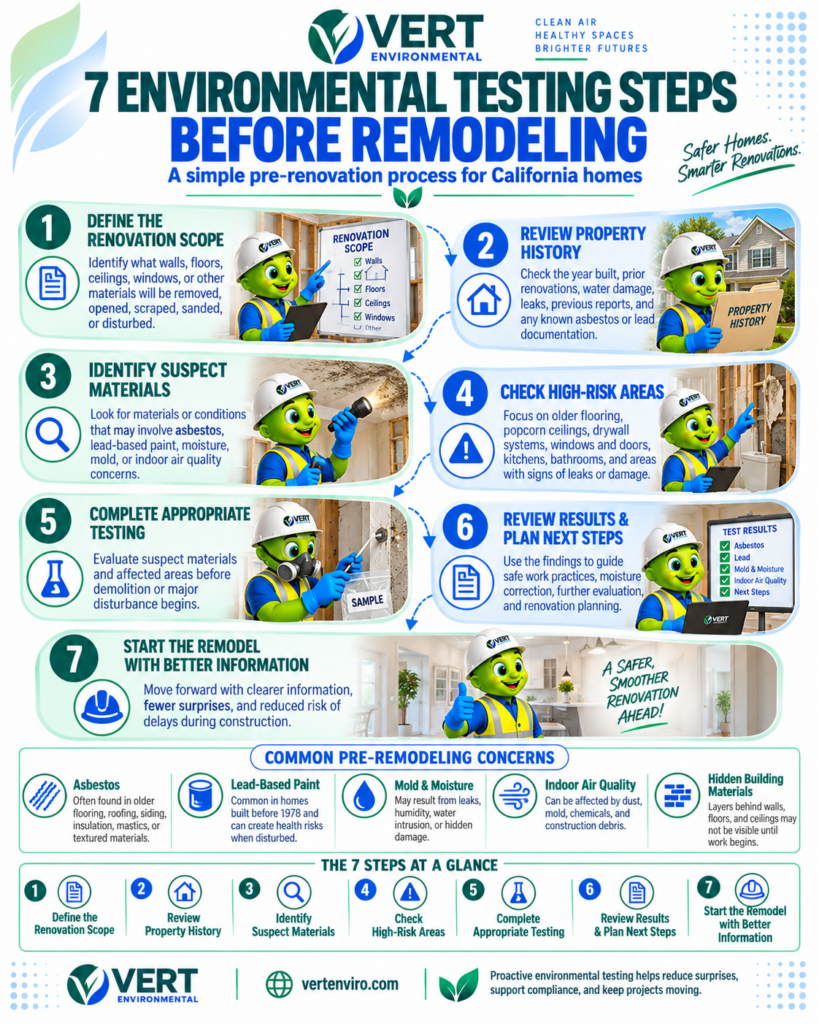
A practical sequence looks like this:
Step 1: Define the Renovation Scope
Determine exactly what will be removed or disturbed.
For example:
- Which walls are coming down?
- Is flooring being removed?
- Is the ceiling being scraped?
- Are cabinets being removed?
- Are windows being replaced?
- Will walls or ceilings be opened?
Step 2: Review the Property’s History
Look at:
- Year of construction
- Previous renovations
- Previous environmental reports
- Known water leaks
- Roof leaks
- Flooding
- Plumbing repairs
- Previous asbestos or lead documentation
Step 3: Identify Suspect Materials
Determine which materials may warrant additional evaluation.
Step 4: Complete Appropriate Inspection or Sampling
When testing is appropriate, have samples or assessments completed before demolition.
Step 5: Review the Results
If asbestos, lead, moisture damage, or another environmental condition is identified, the contractor can account for it in the renovation plan.
Step 6: Begin the Remodel
Once the necessary environmental information has been collected and applicable requirements addressed, the project can move forward with better information.
Why Test Before Construction Instead of After a Problem Is Found?
Consider two scenarios.
Scenario One
Your contractor begins removing the kitchen floor and finds an older layer of flooring with black adhesive underneath.
Work stops.
Now you need to determine whether the newly uncovered material contains asbestos.
The construction schedule may need to change while the material is evaluated.
Scenario Two
The planned flooring system is evaluated before demolition.
Potentially hazardous material is identified before construction begins.
The contractor can account for the findings when planning the job.
The difference is planning instead of reacting.
Benefits of Pre-Renovation Environmental Testing
Appropriate environmental testing before construction may help:
- Identify potential hazards before demolition
- Reduce unexpected construction interruptions
- Give contractors better information when planning the project
- Identify materials that require specific work practices
- Reduce unnecessary disturbance of suspect materials
- Protect areas outside the renovation zone
- Help determine whether additional environmental professionals are needed
- Document conditions before construction begins
- Create a clearer path from demolition to reconstruction
The goal is not to test everything simply because you are remodeling.
The goal is to test or evaluate the conditions that matter for the work you are about to perform.
California Environmental Testing Requirements Can Vary
One of the most important things for California homeowners to understand is that there is not one universal pre-remodel environmental test that applies to every property.
Requirements may depend on:
- Property type
- Building age
- Location
- Materials being disturbed
- Amount of material being disturbed
- Whether contractors or employees are performing the work
- Whether demolition is involved
- Local air-quality district rules
For example, South Coast AQMD requires prior asbestos surveys for applicable renovation and demolition activities within its jurisdiction. For renovation projects, the required survey focuses on construction materials affected by the planned renovation.
There are specific exemptions, including an exemption under South Coast AQMD Rule 1403 for qualifying owner-occupants who personally perform renovation work on their own single-unit residence. That exemption does not broadly apply to contractor-performed remodeling.
San Diego County Air Pollution Control District Rule 1206 also contains requirements for asbestos surveys and regulated renovation or demolition work. For regulated facilities, the district states that an asbestos survey must be completed before renovation or demolition regardless of the building’s age. Residential structures with four or fewer dwelling units are treated differently under parts of the rule, so the details of the specific project matter.
This is why homeowners should not rely on a general statement such as:
“My house isn’t old enough to need testing.”
or:
“It’s just a small remodel, so environmental requirements don’t apply.”
The better approach is to determine what applies to the specific property and project.
California Pre-Renovation Environmental Checklist
Before demolition day, ask these questions:
☐ What year was my home built?
☐ Which walls, ceilings, floors, windows, or other materials will be disturbed?
☐ Will painted surfaces in a pre-1978 home be disturbed?
☐ Are old flooring or adhesives being removed?
☐ Is a popcorn or textured ceiling being removed?
☐ Will insulation or older wall systems be disturbed?
☐ Has the property experienced a roof leak or plumbing leak?
☐ Is there visible water staining?
☐ Are there musty odors?
☐ Is there a history of flooding?
☐ Has the property previously been tested for asbestos?
☐ Has the property previously been tested for lead-based paint?
☐ Are previous environmental reports available?
☐ Does my contractor need environmental documentation before starting work?
☐ Are there local air-quality district requirements that apply to the project?
If several of these questions apply to your remodel, an environmental evaluation before demolition may be appropriate.
Frequently Asked Questions About Environmental Testing Before Remodeling
Do I Need Environmental Testing Before Remodeling?
Not every remodeling project requires environmental testing. The need depends on the property’s condition, the materials being disturbed, the scope of the renovation, and potential environmental concerns such as asbestos, lead, mold, moisture, or indoor air quality.
Requirements vary depending on the property, project scope, location, and materials being disturbed.
What Should I Test Before Demolition?
The most common environmental concerns evaluated before residential demolition or renovation include:
- Asbestos-containing building materials
- Lead-based paint
- Moisture damage
- Mold or suspected microbial growth
- Indoor environmental conditions related to the work area
The appropriate testing should be based on the materials that will actually be disturbed.
What Should Be Tested Before Renovating an Old House?
Before renovating an older home, consider evaluating suspect flooring, adhesives, ceilings, wall systems, insulation, painted surfaces, and areas with evidence of moisture damage.
Older homes may contain several generations of building materials, so the materials visible today may not be the only materials affected during demolition.
Does a House Have to Be Old to Have Asbestos?
No.
Although older buildings are often associated with asbestos-containing materials, building age alone should not be used to determine whether asbestos is present.
In San Diego County, for example, APCD Rule 1206 requires an asbestos survey before renovation or demolition of regulated facilities regardless of the building’s age. Residential buildings with four or fewer dwelling units are generally exempt from parts of that rule, so the requirements depend on the specific property and project.
If suspect material will be disturbed, confirm the requirements that apply to the specific project.
Should I Test a Popcorn Ceiling Before Removing It?
If a popcorn or textured ceiling is suspected of containing asbestos, evaluation should take place before the material is scraped, sanded, cut, or demolished.
Appearance alone cannot reliably determine whether the material contains asbestos.
Do I Need Lead Testing Before Remodeling a House Built Before 1978?
Testing is one option for determining whether affected painted surfaces contain lead-based paint.
For covered renovation work in pre-1978 homes, EPA guidance provides that affected surfaces must either be appropriately tested or treated as containing lead-based paint and handled using applicable lead-safe work practices.
California CDPH also recommends having areas planned for renovation evaluated by a certified lead professional before work begins.
Do I Need Mold Testing Before Remodeling?
Not always.
If visible mold, water damage, or a musty odor already indicates a moisture problem, routine mold sampling may not provide useful additional information.
California CDPH recommends focusing on identifying the source of moisture and correcting the underlying problem.
Professional investigation may still be useful when the location, cause, or extent of a suspected moisture problem is unclear.
Can My Contractor Tell Whether Something Contains Asbestos by Looking at It?
Not reliably.
Many asbestos-containing materials cannot be distinguished from non-asbestos materials visually.
When confirmation is required, appropriate inspection, sampling, and laboratory analysis may be needed before the material is disturbed.
When Should Environmental Testing Be Scheduled?
Ideally, environmental evaluation should be completed before sanding, cutting, drilling, scraping, flooring removal, wall opening, ceiling removal, or demolition begins.
The environmental professional should also understand the scope of the renovation so the evaluation can focus on the materials that will actually be disturbed.
Who Performs Environmental Testing Before a Remodel?
The appropriate professional depends on what is being evaluated.
For asbestos work requiring a formal asbestos survey under applicable California rules, appropriately qualified or certified professionals may be required.
California maintains certification requirements for asbestos consultants and lead-related construction professionals, and local air-quality districts can impose additional requirements.
Your environmental testing provider can help determine which type of assessment is appropriate for the project.
Planning a Remodel? Test Before You Demo.
A remodel is designed to improve your home.
The demolition phase, however, can expose materials and conditions that have remained hidden for years.
Before opening walls, removing old flooring, scraping textured ceilings, replacing windows, or disturbing older painted surfaces, take time to understand what may be present.
For an older California home, that may mean evaluating suspect materials for asbestos or lead.
For a home with previous leaks or water damage, it may mean investigating moisture conditions and affected materials before new finishes are installed.
The purpose of environmental testing before remodeling California homes is not to add unnecessary steps to the renovation.
It is to provide better information before materials are disturbed.
That information can help homeowners, contractors, and environmental professionals plan the renovation more effectively from the beginning.
Schedule Environmental Testing Before Your California Remodel
Planning to renovate, remodel, or demolish part of your property?
Vert Environmental provides professional environmental testing and assessments for asbestos, lead, mold, moisture, and indoor air quality concerns.
Whether you’re remodeling a kitchen, renovating a bathroom, replacing flooring, opening walls, removing a textured ceiling, or preparing for more extensive demolition, identifying potential environmental concerns before construction begins can help you move forward with greater clarity.
Schedule your pre-renovation environmental assessment with Vert Environmental before demolition begins.

Related Articles


Your Home Didn’t Burn. Can Wildfire Smoke Still Contaminate It?
Private Well Water Testing in California: What Should Homeowners Test For?